Case study · Research
What a king vulture's camera reveals
Two king vultures in Costa Rica carried a camera on their backs. More than two hours of footage showed how well behaviour can be read from acceleration data alone, and where it still fails.
How do you check a bird you can't see?
The king vulture is hard to watch. It is an elusive forest specialist that tends to avoid large groups, which makes it difficult to observe wild birds for long periods, and much of its ecology is still poorly understood.
Acceleration sensors can tell what an animal is doing when no one is watching: flying, resting, feeding. But how do you know the classification is right, if you can never see the animal? The team on the Osa Peninsula in Costa Rica found an answer: let the vulture carry the observer.
A camera on the vulture's back
The team combined a GPS-accelerometer tag with a custom camera that records high-definition video with sound, and with a drop-off system: a small microcontroller releases the harness automatically, using a geofence to check where the bird is, so the unit can be recovered.
In May 2024, two adult male king vultures were caught at Cerro Osa and fitted with the prototype. One of them stayed within the geofence and its unit was recovered after a week; the other explored far beyond and was recovered 28 days later. Together they delivered 764 video files and 2 hours 16 minutes of footage.
Where Firetail came in
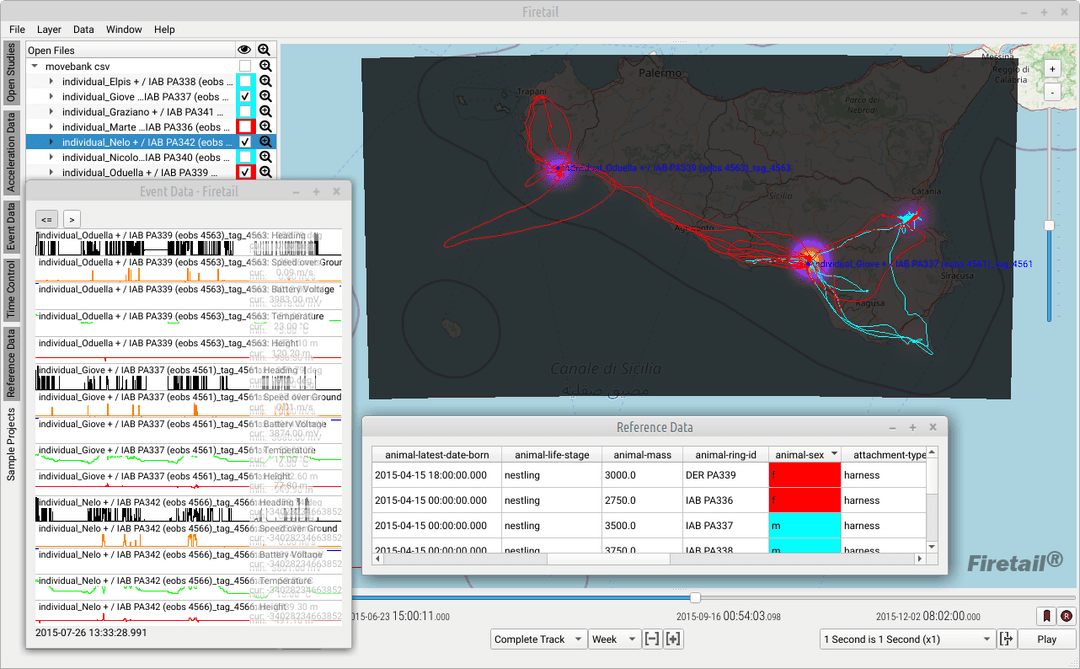
The researchers annotated the behaviour they saw in the videos and matched it with the acceleration data, second by second. Separately, they trained a FireSOM model in Firetail for each vulture, an unsupervised algorithm that sorts acceleration bursts into categories by their patterns, without knowing what the bird was actually doing.
The video annotations were then brought into Firetail as ground truth and compared with the FireSOM output. The GPS tracks served as a cross-check: straight lines fit soaring and gliding, tight clusters fit feeding.
Resting and soaring yes, feeding not yet
- The vultures spent most of their time resting (59–70%), followed by soaring and gliding (about 19%), preening (8–17%) and flapping flight (about 3%).
- Resting and soaring were recognised well from acceleration alone (F1 scores up to 0.89 and 0.94), flapping flight moderately well.
- Preening and especially feeding were hard to tell apart. Feeding was filmed only once, at a large carcass, where GPS showed the bird staying for about 72 hours, alternating between tearing at the carcass and resting.
The study shows both sides: for the main behaviours, acceleration data give a reliable picture of a bird that is almost impossible to observe. For rare behaviours like feeding, more footage and better-synchronised sensors are needed. Once the prototype becomes lighter and better integrated, the authors see camera-equipped tags with drop-off systems as a valuable tool for both research and conservation.
Tobias Petri and Matthias Berger of the Firetail team are co-authors of this study: they supported and validated the analyses with Firetail and provided tailored modules. Study design, data collection and analysis were carried out independently by the other authors. This story is based on the publication.
Get Firetail
free downloadGet started with Firetail today! Interactively process high-density data for multi-animal, multi-year projects!
“No risk: request a three-month trial, kickstart your analysis and see your data in an all-new light!”