Case study · Conservation
Vultures as death detectors
Vultures find carcasses across vast landscapes. In Etosha National Park, GPS-accelerometer tags and machine learning turned 34 white-backed vultures into a monitoring system that detects where animals have died.
Can vultures report where animals die?
Wild animals can act as sentinels, helping with problems from disease outbreaks to human–wildlife conflict and illegal activities. Vultures are a natural choice: they are specialists at finding carcasses. Knowing where animals die matters, for studying the vultures themselves, and for detecting disease outbreaks, poisoning or the illegal killing of wildlife.
But GPS alone can't tell a vulture resting at a spot from a vulture feeding on a carcass. Can acceleration data and machine learning turn a group of tagged vultures into a reliable carcass detector for a huge protected area?
Tagged in Etosha, observed in Berlin
The team tagged African white-backed vultures in Etosha National Park in Namibia, a protected area of more than 22,000 km². The loggers had two modes: a detailed one that recorded GPS and acceleration in parallel every minute for seven seconds, and a saving one with a GPS position every 30 minutes. The acceleration data decided when to switch, and the threshold was set so that feeding would always be recorded in the detailed mode.
To learn what the acceleration patterns mean, the classifier needed a reference data set. Two captive vultures at Tierpark Berlin provided four of the six behaviour classes. Flight, however, could not be observed often enough in an enclosure.
Where Firetail came in
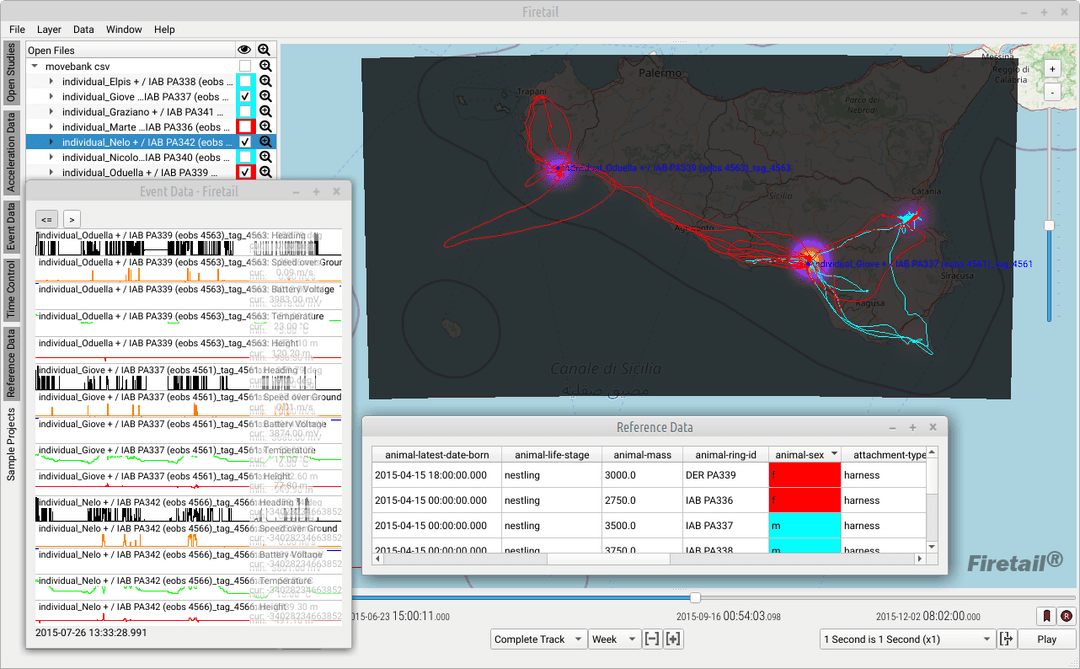
For the two missing classes, active flight with flapping wings and passive flight while soaring, the team turned to the wild vultures. They analysed the acceleration data visually in Firetail and annotated samples of both behaviours, using GPS speed to make sure the birds were actually flying. Together with the zoo observations, this completed the reference data set of 14,682 samples.
From clusters to carcasses
- The behaviour classifier recognised all six classes with high performance (overall precision 0.95, recall 0.89).
- Combined with GPS, the classified behaviour pointed to potential feeding sites. Between May 2022 and March 2023, a ground team checked 1,900 of these clusters in the field: 580 had a carcass, 1,320 did not.
- A second classifier trained on these field checks told clusters with and without a carcass apart with precision 0.92 and recall 0.89.
The result is a system of vultures, loggers and artificial intelligence that can monitor the deaths of many species across a vast landscape. The authors see broad applications, from the feeding ecology of vultures to the early detection of disease outbreaks, poisoning and wildlife crime, and a framework that can be transferred to other species.
“a whole new level of behavioral research [...] The scientist gets up close to the studied animal again”
This story is based on the publication listed here. Are you one of the authors and would like to add something or correct us? Get in touch, we'd love to tell the story in your words.
Get Firetail
free downloadGet started with Firetail today! Interactively process high-density data for multi-animal, multi-year projects!
“No risk: request a three-month trial, kickstart your analysis and see your data in an all-new light!”