Case study · Research
How nesting wild turkeys move and share space
Ten years of GPS tracks from 643 female wild turkeys show that how far a hen roams while laying her eggs, and how many other hens share her area, is linked to whether her nest hatches.
Does the laying period matter?
A wild turkey hen raises her brood alone. She nests on the ground and sits on her eggs for 25 to 30 days, slipping away only to find food while staying hidden from predators. It is a dangerous time: most nests are lost, and hens face a high risk of being killed by predators.
But the risks start earlier, while she is still laying her eggs and moving around her range. Does it matter how far she roams during those days, and whether she shares her area with other hens? Researchers in the southeastern United States set out to answer this with a decade of GPS tracks.
Ten years, 643 hens
Researchers at the University of Georgia and their partners captured female wild turkeys in Georgia, South Carolina and Louisiana from 2014 to 2023 and fitted them with backpack GPS transmitters. The tags recorded hourly locations during the day plus a nightly roost location. In total, the study covers 643 females and 872 nesting attempts, including 246 attempts at renesting after a first nest failed.
Where Firetail came in
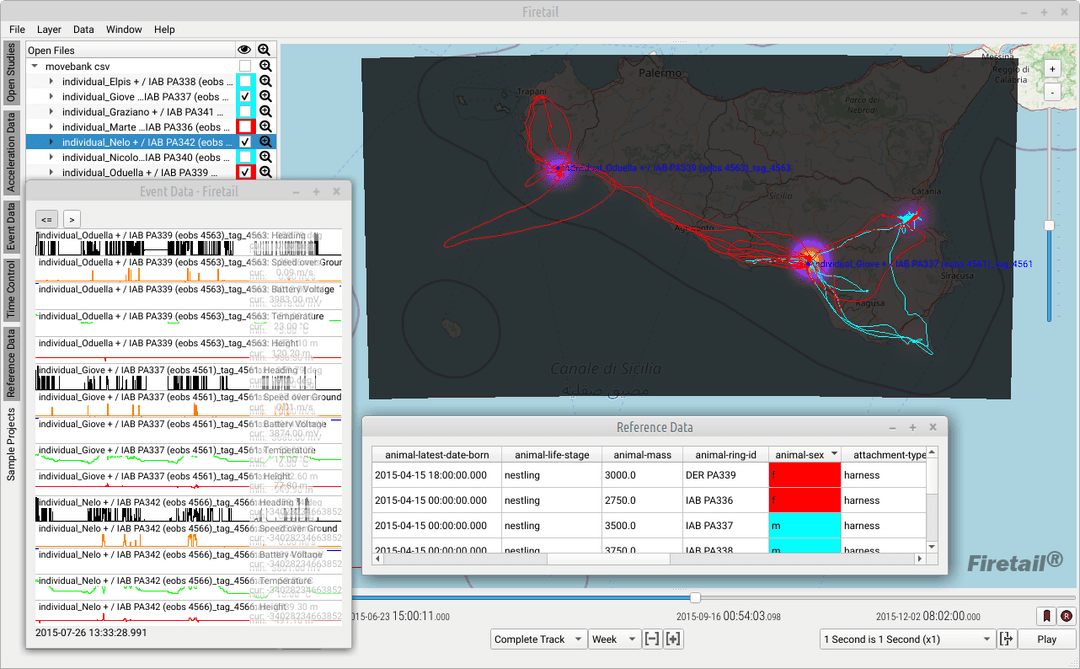
To study the laying period, the team first had to know, for every single nesting attempt, when laying began and when the hen started to incubate. On a map, a nest shows up as locations that concentrate around a single point for several days. The team mapped their spatio-temporal GPS data in Firetail and ArcGIS Pro to pin down these dates, and then analysed movements and space use for each laying period in R.
Sharing space pays off
Only 24% of the 872 nests hatched, and 13% of the nesting females were killed by predators during incubation. Against that background, the laying period mattered:
- With every additional ~700 m in average daily distance travelled during laying, the probability that the nest hatched dropped by 1.73%.
- Each additional female whose core area overlapped with a hen's own increased the probability of nest success by 4.76%.
- Female survival during incubation was only weakly related to movement.
The results suggest that hens gain an advantage from sharing space with other females while they lay their eggs, while their own movements play a smaller role for reproductive success than expected.
“I can't say enough about your product! It's made life much easier for us to monitor our birds”
This story is based on the publication listed here. Are you one of the authors and would like to add something or correct us? Get in touch, we'd love to tell the story in your words.
Get Firetail
free downloadGet started with Firetail today! Interactively process high-density data for multi-animal, multi-year projects!
“No risk: request a three-month trial, kickstart your analysis and see your data in an all-new light!”