
Firetail Hardware
“Not a Tag”
Our development board for movement research
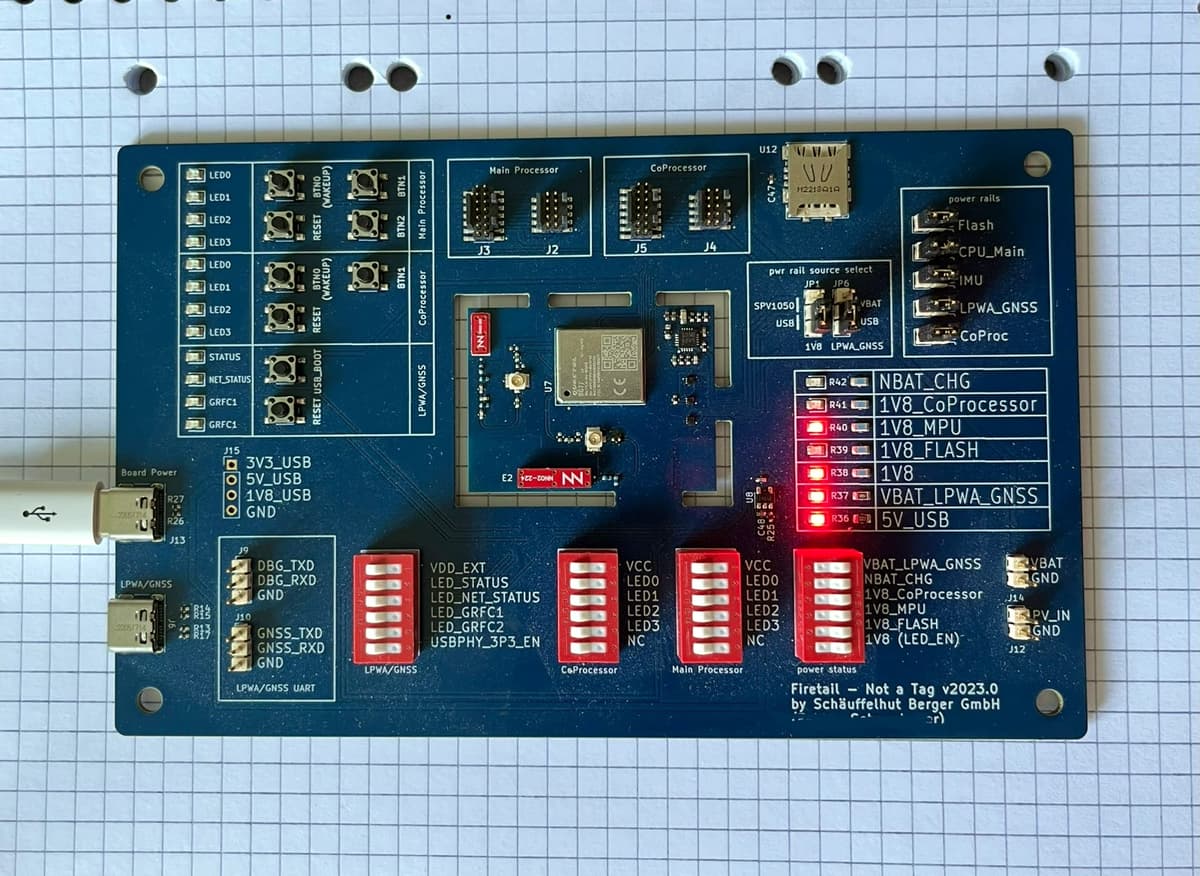
The name says it: this is not a tag. It's a development board carrying the parts of a modern tracking tag (GNSS, a 9-axis motion sensor, LTE-M/NB-IoT, LoRaWAN and a co-processor for on-device algorithms), laid out so that every part can be measured, debugged and changed.
We use it in-house to record high-quality sensor data under known conditions, which helps us improve Firetail's algorithms. Designed by Schäuffelhut Berger GmbH.
Why we built it
Tracking tags
Built for deployment: small, sealed and power-optimised, with their own firmware. Ideal in the field, but not made for changing firmware or trying new algorithms.
Arduino / DIY
Cheap and flexible, but without the sensor quality, power design and cellular connectivity of tag-class hardware.
“Not a Tag”
Tag-class components on a board you can work with: every part measurable, debuggable and programmable.
What we use it for
Recording reference data
Motion and GNSS recordings under known conditions, synchronised with video, go straight into Firetail. They are the ground truth we use to test and improve Firetail's analysis and behaviour tools.
Measuring power
Jumpers on the power rails let us measure each part on its own (GNSS, LTE module, motion sensor, flash) and see what every feature costs in energy.
Testing GNSS, LTE-M and LoRaWAN outdoors
How fast does GNSS get a fix, how far does LoRaWAN reach, what does an upload over LTE-M cost? We take the board outside and measure it.
Writing the software stack
Drivers, data recording, compression and the radio links: the software a tag needs, developed and tested on the board, with full debug access.
Next: algorithms on the tag
Our goal is high-performance algorithms that run directly on tag-class hardware: behaviour classification and other analysis on the device itself, not only afterwards on the desktop. The board's co-processor, a Cortex-M4 with FPU and DSP, is there for exactly that.
Work in progress.
Technical specifications
| Main MCU | STM32WL55 dual-core (Cortex-M4 + M0+) |
| Integrated radio | Sub-GHz LoRa / LoRaWAN, (G)FSK |
| Co-processor | STM32L4Q5CG (ARM Cortex-M4, up to 120 MHz, FPU/DSP for on-device algorithms) |
| Cellular | LTE Cat-M1 / NB-IoT (Quectel BG77) |
| GNSS | GPS, GLONASS, Galileo, BeiDou |
| Motion sensor | 9-axis IMU (ICM-20948: accelerometer, gyroscope, magnetometer) |
| Temperature | Ambient temperature sensor |
| Power | Solar harvesting (MPPT), LiPo battery, USB-C |
| Storage | 2 Gbit SPI flash for local data buffering |
| Debug | JTAG/SWD, debug LEDs, push buttons, power profiling jumpers |
| Form factor | Development board with exposed headers and test points |
Based on a bachelor thesis at the University of Applied Sciences Munich, 2025. Supervised by Friedrich Schäuffelhut, Schäuffelhut Berger GmbH.
Working on algorithms for tags?
“Not a Tag” is our in-house research and development platform and is not available for sale. We'd like to open it to other researchers one day; before that, we have to settle the EU rules for radio equipment. If you work on algorithms for tags, or want to hear about our plans, let's talk.
Get in touch